



At the bottom of a well in northern Italy, archaeologists found bronze figurines that had been placed there roughly 2,500 years ago and, according to the reporting, still hold their metallic lustre.
Above them, from a much later period, lay two human skeletons.
The sequence — offerings at the beginning, bodies at the end — is what makes the find unusual. It appears to record both the opening and the closing of a sacred structure, by a civilisation that left very little written explanation of either.
The site
Kainua is the Etruscan name for the city whose remains lie near modern Marzabotto, in the Apennine foothills south of Bologna. It is among the most systematically excavated Etruscan urban sites anywhere, notable for something rare in the ancient world: a planned grid of streets, laid out deliberately rather than accreted over time.
The University of Bologna has excavated there for decades. This discovery came during its 39th campaign, led by archaeologist Elisabetta Govi, and was reported by Archaeology magazine, published by the Archaeological Institute of America, on 7 August 2026.
The well sits in the city’s religious precinct, close to temples dedicated to Tinia and Uni — the chief god and goddess of the Etruscan pantheon, later absorbed into Roman religion as Jupiter and Juno. Researchers associate this particular well with Uni.
What was in it
At the base: bronze statuettes and a bronze plaque, dated to the late sixth or early fifth century BC — the period when the city was founded. Ceramic material was also recovered.
The interpretation is that these were votive offerings, deposited to secure an adequate water supply for a new settlement.
That is a rational act, not a superstitious one, once you consider the problem. A planned city built on a specific site is a bet on water. Get it wrong and the city fails. There is no engineering test available in the fifth century BC that tells you whether a spring will hold for a century. What exists instead is ritual: a formal act marking the moment the community committed to the site, involving objects of real value, performed publicly.
Bronze was not cheap. Placing worked bronze at the bottom of a well and leaving it there is a costly signal — the community demonstrating, to itself, how seriously it took the commitment.
The skeletons
The two human skeletons come from a later period and were, according to the researchers, deposited when the well was formally closed.
This is the part that will generate the most speculation and deserves the most caution. The reporting describes a ceremonial deposition. It does not establish how these people died, whether their deaths were connected to the closing of the well, or who they were.
What can be said is that structures with sacred significance in many ancient societies were not simply abandoned when they went out of use. They were decommissioned, through acts as formal as those that consecrated them. A well associated with a goddess could not just be filled in.
Beyond that, the honest position is that the analysis has not been done. Osteological examination will establish age, sex, health and possibly cause of death; isotope analysis may indicate where these individuals grew up. Until then, anything more specific is a story rather than a finding.
Why the Etruscans are hard to know
The Etruscans dominated central Italy before Rome, and Rome inherited a great deal from them — augury, aspects of temple architecture, elements of civic ritual, arguably the toga.
But they are unusually difficult to study. Their language, though written in a Greek-derived alphabet that can be read aloud, is not related to any well-understood language family, and the surviving corpus is dominated by short funerary and votive inscriptions. There is no Etruscan literature, no history written by an Etruscan, no theological text.
Almost everything known about Etruscan religion is therefore inferred from two sources: what Roman and Greek writers said about them — outsiders, often centuries later, frequently hostile — and what they left in the ground.
That is why a well like this matters more than its contents would suggest. Govi’s assessment is that the campaign’s results “enrich our knowledge of the foundation rites of Etruscan cities.” Each such deposit is a data point in a reconstruction being assembled almost entirely from physical evidence.
Why the bronze survived
The preservation is not a coincidence, and the mechanism is worth knowing.
Bronze corrodes through reaction with oxygen. At the bottom of a well, objects sit in waterlogged, oxygen-poor sediment. Corrosion effectively stalls. The same conditions preserve wood, leather and textiles that would vanish entirely in ordinary soil, which is why wells, bogs and waterlogged deposits are disproportionately important in archaeology.
It also means excavation is delicate. Objects stable for millennia in anaerobic conditions begin degrading as soon as they meet air. Conservation starts at the moment of lifting, not afterwards.
If you want to see it
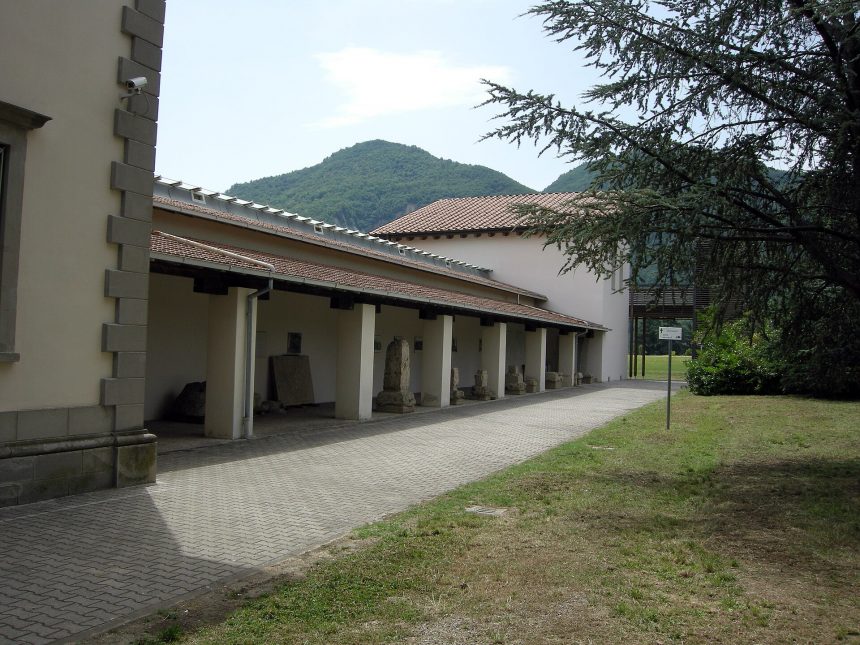
The artefacts are to be transferred to the National Etruscan Museum in Marzabotto after conservation and analysis. No exhibition date has been announced, and conservation of waterlogged bronze is not quick.
The site itself is open in the meantime, and is a genuinely worthwhile stop for anyone in the Bologna area:
- Where: Marzabotto, in the Reno valley roughly 30 km south of Bologna, reachable by regional train.
- What you see: the excavated street grid, the acropolis with its temple foundations, and a necropolis — a planned Etruscan city visible in plan, which is rare.
- The museum: the National Etruscan Museum sits beside the archaeological park and holds material from the site.
- Worth knowing: this is a working excavation, not a reconstructed attraction. It rewards reading something first, and it is quiet compared with Italy’s headline sites.
Marzabotto carries a second history that visitors should be aware of: it was the site of one of the worst civilian massacres in Italy during the Second World War, and there is a separate memorial to it in the town. The two histories sit a short distance apart.
What to watch
- Analysis of the skeletons — the finding that would most change the interpretation.
- Publication of the campaign results in the archaeological literature, where the evidence can be assessed properly.
- The 40th campaign. A site excavated for thirty-nine seasons and still producing finds of this kind is not close to exhausted.
How a civilisation is reconstructed from deposits
Because the Etruscans left no literature, almost everything known about their religion has been assembled from what they buried, and it is worth understanding how that inference works.
Archaeologists distinguish between material that was discarded and material that was deposited. Rubbish accumulates without intention and tells you about daily life — diet, craft, trade. Deposits are placed deliberately, and the placement itself carries meaning.
Several features mark a deposit as ritual rather than accidental. The objects are valuable, so their loss was a cost willingly borne. They are arranged rather than scattered. They are complete, or deliberately broken in a patterned way — ritual breakage, “killing” an object so it passes out of use, is a recognised practice across many cultures. And the location is significant: a sanctuary, a boundary, a foundation, a well.
The Kainua well satisfies most of these. Worked bronze at the base of a shaft in a temple precinct, dated to the city’s foundation, is not material that arrived by accident.
What such a deposit cannot tell you is what the people believed. It records that a formal act was performed, at a particular moment, involving real expense. The meanings attached to it — which words were spoken, what the participants thought was happening — are not recoverable from the objects. Honest archaeology stops there, and it is where popular accounts usually keep going.
Foundation and closure rites, in wider context
The pattern visible here — offerings at the creation of a structure, further acts at its decommissioning — is documented across many ancient societies, which is part of why the interpretation is credible.
Foundation deposits are widespread: objects placed beneath temple corners in Mesopotamia, under Egyptian building foundations, beneath the thresholds of houses across the Mediterranean and Near East. The logic is recognisable even now, in the coins placed under a ship’s mast or the ceremonial laying of a cornerstone.
Closure or termination rites are less familiar to modern readers but equally attested. Structures with sacred associations were not simply abandoned. They were decommissioned through formal acts — sealed, filled, sometimes deliberately burned — because a space that had been consecrated could not casually revert to ordinary use.
Human remains appear in some such contexts, and their interpretation varies enormously and is frequently contested. Burial of the honoured dead, secondary burial of remains moved from elsewhere, and sacrificial deposition are all documented somewhere, and they can be difficult to distinguish from the physical evidence alone. Which applies at Kainua is exactly what the osteological work has yet to establish.
What the Romans took from them
The Etruscans are often introduced as a civilisation Rome erased. The more accurate description is a civilisation Rome absorbed, and the debt is substantial.
Roman augury — reading the will of the gods from bird flight, lightning, and the livers of sacrificed animals — was substantially Etruscan in origin, and Etruscan specialists, the haruspices, were consulted in Rome for centuries after Etruscan political power ended.
The Etruscan temple form, with its deep porch, high podium and frontal orientation, shaped Roman temple architecture and, through it, a great deal of later Western public building.
Roman tradition itself held that several early kings of Rome were Etruscan, and that major public works including the Cloaca Maxima were built under them. The toga, the curule chair, aspects of triumphal ceremony and the practice of laying out a city on ritually determined axes all have Etruscan antecedents.
That last one is directly visible at Kainua. The grid is not merely practical planning; the orientation of Etruscan cities was determined by ritual procedure, dividing space along axes established by augury. A planned Etruscan city is a religious document as much as an urban one — which is why a well in its sacred precinct is not a peripheral find.
Reading the language, without understanding it
One of the more curious facts about the Etruscans is that their writing can be read but largely not understood.
They used an alphabet derived from Greek, so the sound values of the letters are known. Any competent scholar can pronounce an Etruscan inscription aloud.
The obstacle is that the language is not related to Latin, Greek, or any other well-attested language family — it is effectively isolated, with only distant proposed connections. There is no linguistic relative to work from.
What exists is a corpus of perhaps thirteen thousand inscriptions, overwhelmingly short and formulaic: names, dedications, funerary markers. Vocabulary appearing repeatedly in clear contexts — kinship terms, numerals, offices, deity names — is understood. Longer texts are not.
This is why a bronze plaque from a votive deposit is potentially significant beyond its craftsmanship. Inscribed objects from securely dated, well-documented contexts are the raw material for extending that vocabulary. Whether this plaque carries an inscription, and whether it is legible, was not stated in the initial reporting — and it is among the details worth watching for when the campaign is formally published.
Sources
- Archaeology Magazine (Archaeological Institute of America), “Bronze Artifacts Discovered at Bottom of Etruscan Well,” 7 August 2026 — archaeology.org
- HeritageDaily, “2,500-year-old Etruscan treasure found in ancient well,” August 2026 — heritagedaily.com
- Discover Magazine, “A 2,500-Year-Old Etruscan Well Began With Bronze Offerings and Ended With Two Human Skeletons,” August 2026 — discovermagazine.com
- Arkeonews, “Bronze Votive Offerings to Goddess Uni Found in Ancient Etruscan Well at Kainua,” August 2026 — arkeonews.net