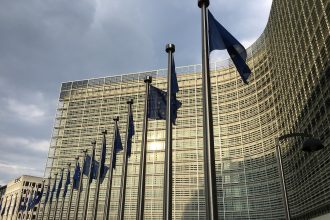




If you have been told you will soon need a €20 online authorisation to visit Europe, you can stop worrying about it for now. The European Union has quietly removed the launch date for ETIAS from its materials, and officials confirmed in August that there is no official date at all.
A 2027 start is now considered most likely.
What ETIAS is
The European Travel Information and Authorisation System is a pre-travel screening requirement for people who do not need a visa to enter Europe — citizens of the United States, the United Kingdom, Canada, Australia and dozens of other countries.
It is not a visa. It is closer to the American ESTA: an online application, submitted before travel, checked against security and migration databases, producing an authorisation linked to your passport.
The published parameters:
- €20 per application.
- Required for travel to 30 European countries.
- No fee for applicants under 18 or over 70.
What actually happened
In mid-July 2026, the European Commission removed the “last quarter of 2026” target from its official materials. By 18 August 2026, EU officials confirmed there is no longer any official launch date.
The stated reasons are not primarily about ETIAS itself. They are about what happened to its sibling system.
The Entry/Exit System, and what went wrong
The Entry/Exit System (EES) became fully operational across the Schengen area on 10 April 2026, following a phased rollout that began on 12 October 2025.
EES replaced manual passport stamping for non-EU nationals on short stays. Instead of an ink stamp, travellers are registered biometrically — fingerprints and a facial image — at their first crossing, with entries and exits recorded digitally.
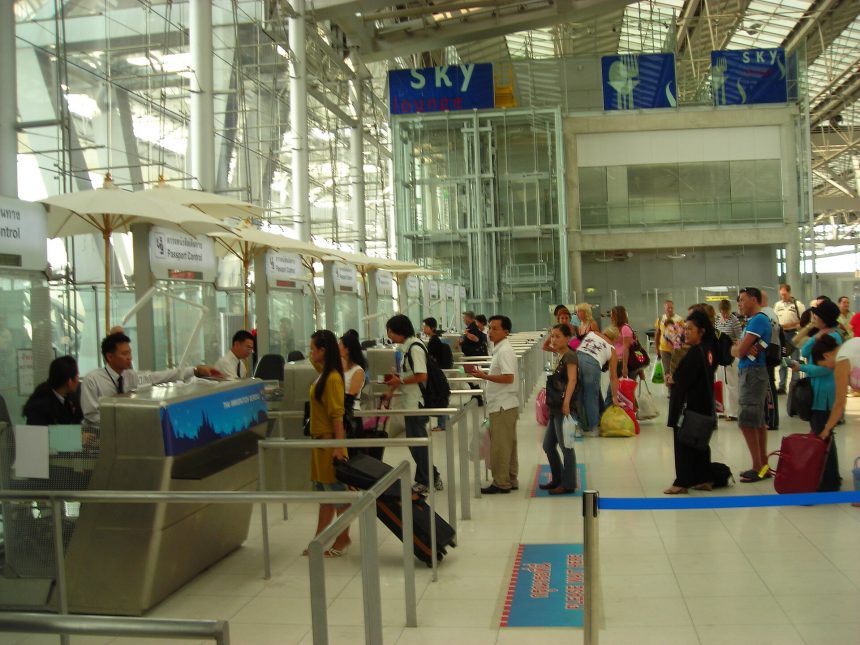
The deployment was, in the EU’s own description, uneven. Roughly twenty “difficult spots” were acknowledged where long queues built up at airports and land borders.
The arithmetic is unforgiving. Manual stamping takes seconds. Biometric enrolment — capturing fingerprints, a facial image, and confirming the record — takes minutes on first registration. Multiply a few extra minutes across a peak-hour arrivals hall and the queue does not lengthen gradually; it exceeds the physical capacity of the hall.
On 1 July 2026, aviation industry groups warned the situation had reached a “critical point.” Nine European countries reportedly asked the EU to ease EES checks. The EU declined.
EU Home Affairs Commissioner Magnus Brunner attributed part of the ETIAS delay to member states’ “insufficient staffing, inadequate infrastructure” — issues separate from the EES problems, but pointing at the same underlying constraint.
Why one delay follows from the other
The two systems were designed to work together. EES records who crosses and when; ETIAS screens people before they travel. ETIAS was always meant to follow EES by a few months.
Layering a new pre-authorisation requirement on top of a border process that is already producing queues would have added a second point of failure: travellers arriving without valid authorisation, needing resolution at the desk, in halls already at capacity.
Postponing is, in that light, the conservative choice. It is also an admission that the first system is not yet working as designed eighteen months after its rollout began.
What travellers should actually do
This is the practical part, and it is short.
Right now: nothing. The ETIAS application portal is not open. There is no fee to pay and no form to complete.
Be wary of sites offering to “pre-register” you. A system with no launch date cannot accept applications. Any site charging you today for an ETIAS application is selling something that does not exist. When the system does open, the official portal will be on an europa.eu domain, and the fee will be €20.
You will get warning. The EU has said it will “announce a start date several months before ETIAS becomes operational.” This is not a requirement that will appear without notice.
EES already applies. If you are a non-EU national travelling to the Schengen area now, you are subject to biometric registration at your first crossing. Allow extra time at the border, particularly on a first trip since the system came in, and particularly at land crossings.
A note on sourcing
Readers should know where this information comes from. The European Commission is the authoritative source on EES status and publishes it directly. The reporting that ETIAS has lost its launch date comes largely from industry trackers and specialist travel outlets monitoring the eu-LISA process, rather than from a formal Commission announcement — because the change was a quiet removal of a date, not a declaration.
Before booking travel, verify current entry requirements with the relevant government authority or your airline. Requirements change, and a news article is a snapshot.
Why this keeps slipping
EES had already missed several deadlines since it was first targeted for 2022. ETIAS has now joined it.
The reason is structural rather than incompetent. These systems must work identically across dozens of national border authorities with different IT infrastructure, different staffing levels, different procurement cycles and different physical facilities. The system is only as fast as its slowest border post, and the EU cannot simply direct a member state to rebuild an arrivals hall.
Both systems trace back to the security and migration pressures of 2015–16, when the EU moved to tighten external border checks. The policy decision was made a decade ago. The implementation is a question of concrete, staffing and software integration, and those have their own timelines.
What to watch
- The eu-LISA management board, expected to discuss a revised ETIAS timeline in September 2026.
- Whether EES queues ease after the summer peak — the practical precondition for adding ETIAS on top.
- A formal Commission announcement of a launch date, which by the EU’s own commitment should arrive several months before the system goes live.
Why biometric enrolment is slower than a stamp, in numbers
The queue problem is arithmetic, and it is worth setting out because it explains why the EU could not simply add staff and move on.
A passport stamp is one action: open, look, stamp. It takes a few seconds and requires no equipment beyond ink.
First-time EES enrolment involves capturing four fingerprints, taking a facial image, checking both against existing records, creating a file, and linking it to the travel document. Each step can fail and need repeating — fingerprint capture is notoriously unreliable with dry skin, worn ridges, or a traveller who does not understand the instruction in the language it is given.
Call it a few minutes rather than a few seconds. Now apply that to a widebody aircraft landing with 300 non-EU passengers, and several arriving within the same hour.
The queue does not grow proportionally. Below the hall’s processing capacity, queues stay short. Above it, they grow without bound until arrivals stop. A modest per-passenger increase pushes a border post from comfortably under capacity to comfortably over it, and the visible result is a hall that was fine last year and is now unmanageable at peak.
There is a genuine mitigation: enrolment is one-time. A returning traveller already in the system passes far more quickly. The system’s steady state is faster than stamping; its transition period is much slower. The EU is living through the transition.
What ETIAS will and will not check
It is worth being clear about what the authorisation actually does, because it is frequently described as either trivial or as a visa, and it is neither.
An ETIAS application collects identity and passport details, contact information, the intended first country of entry, and answers to questions on criminal convictions, recent conflict-zone travel and prior immigration refusals. These are screened automatically against EU security, border and migration databases.
The great majority of applications are expected to be approved automatically within minutes. A minority flag for manual review, which takes longer. A small number are refused, with a right of appeal.
Two limits matter for travellers. First, an authorisation is not a guarantee of entry — a border officer retains discretion on arrival, exactly as with the American ESTA. Second, it is tied to your passport: a new passport requires a new authorisation, whatever validity remains on the old one.
The pattern this belongs to
ETIAS and EES are part of a broader international shift toward pre-travel screening, and the direction is consistent across jurisdictions.
The United States introduced ESTA in 2009. Canada introduced its eTA in 2016. The United Kingdom has been rolling out its Electronic Travel Authorisation. The EU is the largest bloc still to complete the transition.
The common logic is to move the decision earlier: screen before departure rather than at the border, so that a person who will be refused entry is identified before boarding rather than after landing. That is genuinely more efficient for everyone involved, including the traveller who would otherwise be returned at their own inconvenience.
The cumulative effect on individuals is less discussed. Visa-free travel used to mean turning up with a passport. It increasingly means an application, a fee and an approval — smaller than a visa, but no longer nothing, and multiplying as each jurisdiction adds its own.
What to do about the fraud problem
Every one of these schemes has generated an ecosystem of look-alike sites charging a “service fee” on top of the official price, or simply taking payment for nothing. They are typically well-designed, rank highly in search, and use official-sounding domain names.
ETIAS is unusually exposed to this right now, because there is heavy public awareness that the requirement is coming and no official portal against which to compare.
Three rules that hold across every such scheme:
- Government systems live on government domains. For ETIAS that means
europa.eu. Not a lookalike, not a national-sounding variant. - You cannot apply before a system exists. Any site accepting ETIAS applications today is not processing anything.
- The official price is the whole price. €20, free for under-18s and over-70s. A higher figure means an intermediary is taking a cut for filling in a form you can complete yourself.
Entry requirements change frequently and at short notice. Always verify with the relevant embassy, consulate or official government source before booking and again before departure.
Sources
- European Commission, Migration and Home Affairs, “Entry/Exit System (EES)” — home-affairs.ec.europa.eu
- Teach and Travel, “ETIAS Delayed: No Official Launch Date,” 18 August 2026 — teachtravel.org
- etias.com, “ETIAS drops 2026 date as launch slips out of view,” 16 July 2026 — etias.com
- etias.com, “EU eyes ETIAS delay amid EES border chaos,” 2026 — etias.com