



Four astronauts were scheduled to launch to the International Space Station on 12 September. On 29 August, NASA and SpaceX announced the flight was being postponed after ground teams found an oxidizer leak in the Dragon spacecraft’s propulsion system.
No new date has been set.
What was found
The leak was identified during standard prelaunch processing at Cape Canaveral Space Force Station in Florida — the routine checks every vehicle goes through before it is cleared for flight.
NASA’s statement was brief: joint NASA and SpaceX teams are performing additional tests and data review, and “will complete any necessary rework prior to launch.” A new target date will be announced when available.
That phrasing is worth reading precisely. “Additional tests and data review” means the teams are still characterising the problem: where the leak is, how large, whether it indicates a component fault or an assembly issue. Until that is known, a launch date cannot be set, because nobody yet knows what the fix involves.
Why an oxidizer leak stops everything
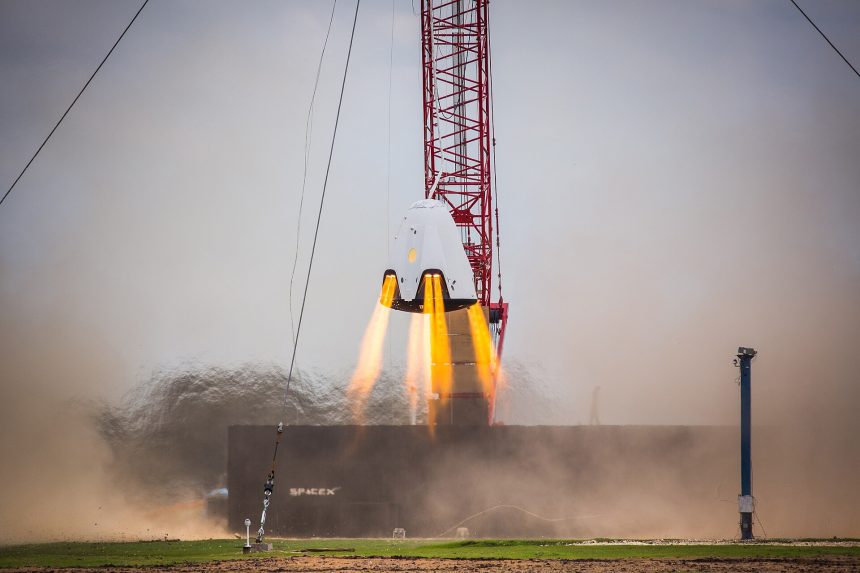
Dragon’s manoeuvring system uses hypergolic propellants — a fuel and an oxidizer that ignite spontaneously on contact, with no igniter required.
That property is exactly why spacecraft use them. A thruster that fires simply by opening two valves is mechanically simple and extremely reliable, which matters when the manoeuvre in question is the deorbit burn bringing a crew home.
It is also why a leak is treated with the seriousness it is. Hypergolic oxidizers are highly corrosive and toxic, and if oxidizer and fuel meet anywhere other than inside a combustion chamber, they ignite there. A small leak in a sealed compartment is not a maintenance item to be watched. It is a hazard to the vehicle and to the ground crews working around it.
There is no version of this system where a known leak is acceptable. The propulsion system is what performs the abort manoeuvre if something goes wrong during ascent, and what brings the capsule out of orbit at the end of the mission. Both are situations in which the crew has no alternative.
The crew
Crew-13 is an international complement, bound for Expedition 75:
- Jessica Watkins (NASA) — commander
- Luke Delaney (NASA) — pilot
- Joshua Kutryk (Canadian Space Agency)
- Sergey Teteryatnikov (Roscosmos)
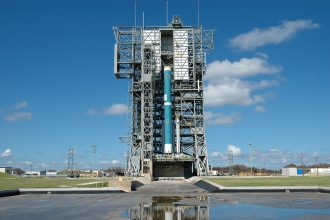
The mission flies on a Falcon 9 from Space Launch Complex 40.
The presence of NASA, CSA and Roscosmos crew on one American commercial vehicle is a reminder of something easily lost in coverage of geopolitics: the ISS crew rotation has continued as a joint operation throughout considerable friction between the partner governments.
What a delay actually costs
Crew rotations are not standalone events. They are one part of a schedule with dependencies in several directions.
Quarantine. Standard NASA protocol places the crew in health stabilisation at Johnson Space Center in Houston roughly two weeks before flight, isolating them so nobody carries an infection to a closed environment where a routine illness is a serious operational problem. A slip means either extending quarantine or releasing and restarting it.
Handover. Arriving and departing crews overlap deliberately, so the outgoing crew can hand over experiments and vehicle specifics in person. A delay compresses that overlap — or, if the outgoing crew must leave on schedule for their own vehicle-lifetime reasons, eliminates it.
Science. Experiments aboard the station are scheduled against crew availability. Some are time-sensitive: biological samples with defined lifetimes, or observations tied to particular orbital or seasonal conditions.
The launch queue. Range time at Cape Canaveral is shared across a busy manifest. A vehicle that misses its window does not simply go the following week; it goes when the range, the recovery assets and the orbital mechanics next align.
The right way to read this
A postponement announcement reads as a setback. In a crewed programme it is closer to the opposite.
The system worked exactly as designed: routine inspection found a fault, the fault was disclosed publicly within days, and the flight stopped. The failure mode that kills astronauts is not finding a problem. It is finding one and flying anyway because a schedule had momentum — which is, in outline, the institutional history behind both Space Shuttle losses.
NASA and SpaceX have delayed crewed missions before for precautionary propulsion reviews. That this happened during ground processing, weeks before launch and with the crew nowhere near the vehicle, is the least costly point in the sequence at which it could have been caught.
The context nobody controls
Since 2020, Dragon has been the primary route for American and partner crews to the ISS under NASA’s Commercial Crew Program, flying rotations roughly twice a year. Soyuz continues to fly, and seat-exchange arrangements mean each vehicle usually carries a mix of crew — deliberate redundancy, so that a problem with one vehicle does not strand one nation’s astronauts.
The station itself is operating on an extended timeline, and the number of remaining crew rotations before it is retired is finite and known. Each delay uses up schedule margin that cannot be recovered later.
None of that argues for flying sooner. It is the reason the margin exists.
What to watch
- The root cause. Whether the leak traces to a specific component, a batch issue, or an assembly procedure — which determines whether this affects one capsule or the fleet.
- Repair or replace. Whether the affected hardware is fixed in place or swapped, which sets the length of the delay.
- The new target date, and how it fits against the outgoing crew’s return.
- Whether the fix propagates to other Dragon vehicles in the fleet.
How hypergolic propulsion works, and why it is chosen anyway
The word “hypergolic” describes a property rather than a substance: two chemicals that ignite on contact, without a spark, a glow plug or any ignition system at all.
Consider what that removes. A conventional rocket engine needs an igniter, and an igniter is a component that can fail. In space, a failed ignition on a deorbit burn is not a delay — it is a crew that cannot come home. A hypergolic thruster fires because two valves opened. There is no ignition step to go wrong.
The propellants also store as liquids at ordinary temperatures. Cryogenic fuels like liquid hydrogen must be kept at extreme cold and boil off continuously, making them unsuitable for a spacecraft that may need to fire its thrusters after six months docked to a station. Hypergolics sit in their tanks indefinitely and work when commanded.
The price of that reliability is toxicity and corrosiveness. These are among the most hazardous chemicals routinely handled in aerospace. Ground crews load them in full protective suits, in cleared areas, under strict procedure. A leak is a chemical hazard to people before it is ever an engineering problem for the vehicle.
Which is why “we found a leak” and “the launch is postponed indefinitely” are the same sentence in this context. There is no monitoring-and-proceeding option.
What “additional tests and data review” is actually doing
NASA’s phrasing is deliberately unglamorous, and it describes a specific investigative sequence.
Locate it. Propulsion systems are dense assemblies of tanks, lines, valves and thrusters, much of it behind structure. Finding exactly where a leak originates can require partial disassembly, pressure-decay testing on isolated segments, or sensor data reconstruction.
Quantify it. Leak rate determines severity. A seep detectable only by instrumentation is a different problem from a measurable flow.
Classify it. This is the question that matters most. Is it a defective individual component, a manufacturing batch issue, a design margin problem, or an assembly error? A single bad valve affects one capsule. A batch issue affects every vehicle that received parts from that lot. A design issue affects the fleet.
Then fix it, and prove the fix. Repair or replacement, followed by re-testing the whole system, not just the repaired section — because disassembly and reassembly introduces its own opportunities for error.
Only after that sequence can anyone set a date. This is why NASA said a new target “will be announced once available” rather than naming a week: at the point of the announcement, the teams did not yet know what they were fixing.
The institutional memory behind the caution
Human spaceflight organisations are shaped by their accidents, and the reflex to stop is a learned one.
The two Space Shuttle losses were both investigated as organisational failures as much as technical ones. In each case, engineers had raised concerns about a known issue; in each case the concern was weighed against schedule and judged acceptable; in each case the reasoning was internally coherent and wrong. The resulting accident reports described a pattern in which repeated success with a known anomaly gradually redefines it as normal.
The countermeasure is procedural: a known unresolved anomaly stops the flight, and the burden of proof sits with proceeding rather than with pausing. That is what happened here, weeks in advance, on the ground.
Read that way, a postponement announcement is the system reporting that it worked.
The wider schedule this sits inside
Crew rotations are the visible part of a continuous logistics operation. The station also depends on uncrewed cargo flights carrying food, water, experiment hardware and spare parts, and on periodic reboosts to counter the same atmospheric drag that is pulling down ageing satellites.
Each crewed vehicle also has a certified on-orbit lifetime. A Dragon docked to the station is rated for a defined period, which sets an outer bound on how long the crew it delivered can stay. A delayed launch therefore does not simply shift one date; it compresses the window at the far end too.
With the ISS operating on an extended but finite timeline, the number of remaining rotations is known. Schedule margin exists precisely so that a fault found during ground processing can be fixed without anyone arguing about whether there is time.
Sources
- NASA, “NASA, SpaceX Adjust Crew-13 Launch Date,” 29 August 2026 — nasa.gov
- Space.com, “SpaceX, NASA delay next astronaut launch to ISS due to leak on Dragon spacecraft,” 2026 — space.com
- ScienceDaily, “NASA delays Crew-13 launch after leak found on SpaceX Dragon,” 1 September 2026 — sciencedaily.com