



On 26 August, NASA switched the science instruments on the Swift observatory back on. After more than a year of trying to save the twenty-one-year-old telescope, the decision amounts to this: it will keep working until it falls.
Reentry is not expected before October.
Why a working telescope is falling out of the sky
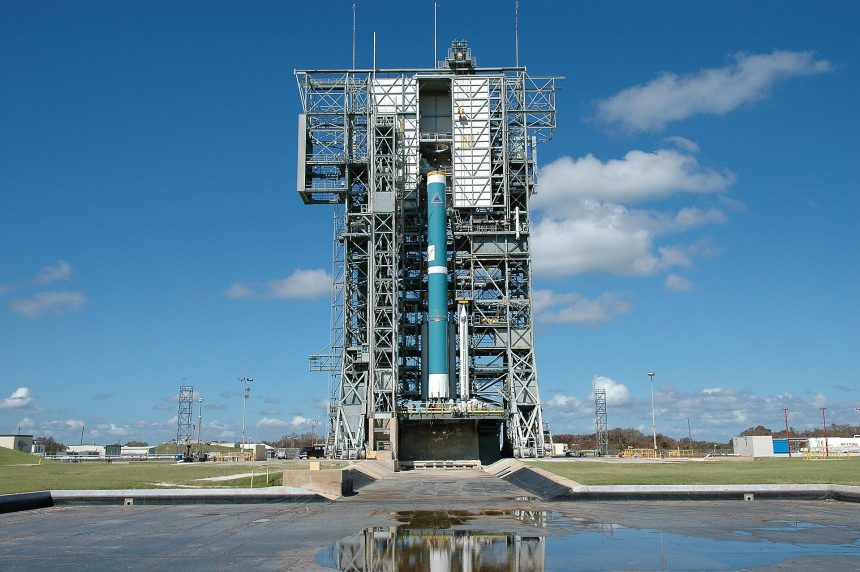
The Neil Gehrels Swift Observatory launched on 20 November 2004 aboard a Delta 7320 rocket, built to catch gamma-ray bursts — the brightest explosions in the universe, most lasting seconds. Swift’s defining trick was speed: detect a burst, slew the spacecraft, and get its X-ray and ultraviolet telescopes onto the target within about a minute, while the afterglow is still bright.
It has done that for two decades, well past its design life.
The problem is not the instruments. It is the air. Low Earth orbit is not empty; a thin residue of atmosphere produces constant drag. How thick that residue is depends on the Sun. During periods of high solar activity, extreme ultraviolet output heats the upper atmosphere and it expands — pushing measurable density up to altitudes where it is normally negligible.
Recent solar activity has done exactly that, and Swift has been losing altitude faster than planners assumed. It carries no propulsion capable of raising its own orbit. It has no way to save itself.
The $30 million rescue that did not work
In September 2025 NASA awarded a $30 million contract to Katalyst Space Technologies, an Arizona company, to build a servicing spacecraft called LINK. Its task: rendezvous with Swift, attach, and boost it into a stable orbit.
The stakes were larger than one telescope. In-orbit servicing has been discussed for decades and demonstrated rarely. A successful Swift rescue would have been visible proof that an ageing science mission can be saved commercially rather than abandoned — a template with implications across a fleet of satellites facing the same slow descent.
LINK launched on 3 July 2026 aboard a Northrop Grumman Pegasus. Shortly after launch, it lost attitude control.
The spacecraft began tumbling at up to roughly 9 degrees per second, with two reaction wheels inoperable and reduced thruster capability. Engineers spent weeks fighting it down: by 6 August the spin was reduced to 1.47 degrees per second, and by 11 August there was enough control to charge batteries and hold communications.
Stabilised, but not capable of the job. Rendezvous and capture of an uncooperative target — Swift has no docking fixture and no way to assist — demands fine, reliable attitude control. On 18–19 August, NASA and Katalyst cancelled the capture-and-boost operation. LINK will now attempt rendezvous and proximity-operations testing only: approach, hold station, gather data, do not touch.
That is not nothing. Proximity-operations data is genuinely valuable to the servicing industry. But it is not what the money was for.
The decision to keep observing
With the rescue abandoned, NASA faced a choice about a spacecraft with a known and shortening life.
On 26 August, the Ultraviolet/Optical Telescope and the X-Ray Telescope resumed operations. The Burst Alert Telescope, which spots the bursts the other two then examine, was expected to follow within weeks.
The logic is straightforward. Swift’s altitude was above 300 kilometres and not expected to drop below that for one to two months. Below roughly that altitude, drag increases sharply and the descent accelerates. Between now and then, the instruments work. Every gamma-ray burst caught in that window is data that would otherwise not exist — and once Swift is gone there is no direct replacement for its particular combination of rapid slewing and multi-wavelength follow-up.
“Swift is not likely to reenter sooner than October,” said Alise Fisher, a Public Affairs Specialist in Astrophysics at NASA Headquarters.
Where it comes down
Swift will not burn up entirely. Dense components — reaction wheels, mirror assemblies, structural fittings — can survive reentry heating.
Its orbital inclination confines the possible reentry footprint to a band between roughly 21 degrees north and 21 degrees south. That band is mostly ocean, but it also contains a great deal of inhabited land: much of Central America, northern South America, central Africa, southern India, South East Asia.
Ewan Wright, a doctoral researcher at the University of British Columbia who studies space debris, put it carefully: “The most likely outcome is that any surviving debris will land in the sea, but there is a chance it could impact a built-up area.”
That is an honest statement of a small but non-zero risk, and it is the standard situation for every uncontrolled reentry — of which there are many. Precise timing and location cannot be predicted far in advance, because atmospheric density in the final days depends on solar activity that is itself only forecastable a few days out.
What this episode actually demonstrates
It would be easy to read the LINK failure as evidence that satellite servicing does not work. That is the wrong conclusion, and the right one is more uncomfortable.
LINK did not fail at the hard part. It never reached the hard part. It failed at attitude control — a mature, well-understood function that most spacecraft perform without incident. The difficult, novel elements of the mission were never tested.
What the episode does illustrate is the gap between a demonstration and an operational service. A servicing capability that must work first time, with no backup vehicle and a target on a deadline, is a different proposition from one that can absorb a failure and try again. NASA had one attempt. It did not survive an ordinary malfunction.
There is a second, quieter lesson about planning assumptions. Swift’s orbital lifetime was projected using models of atmospheric density that solar activity has outrun. That is not a mistake unique to this mission: a great many satellites in low Earth orbit are being pulled down faster than their operators expected, and the ones without propulsion have the same non-options Swift has.
What to watch
- The Burst Alert Telescope coming back online, restoring the full detect-and-follow capability for whatever time remains.
- LINK’s proximity operations — the salvage value of the mission, and worth watching on its own terms.
- Reentry tracking. Predictions will tighten from months to days to hours as the altitude falls.
- The gap afterwards. Whether anything is planned to take over Swift’s role in the rapid-response network linking gravitational-wave detectors, neutrino observatories and optical telescopes.
What Swift was built to catch
Gamma-ray bursts are the most energetic explosions known, and their observational problem is that they are brief.
A burst can release more energy in seconds than the Sun will emit across its entire ten-billion-year life. Long bursts, lasting more than about two seconds, are associated with the collapse of massive stars into black holes. Short bursts come from mergers of neutron stars.
The difficulty is timing. A burst is detected, then fades. The afterglow — the emission from material shocked by the explosion — carries most of the scientific information, and it decays fast. Before Swift, by the time coordinates reached a telescope capable of studying the afterglow, much of it was gone.
Swift’s contribution was mechanical. Its Burst Alert Telescope watches a wide field for the initial gamma-ray flash. On detection, the spacecraft autonomously slews to point its X-ray and ultraviolet telescopes at the position, typically within about a minute, and simultaneously broadcasts coordinates to ground observatories.
That capability — detect, turn, observe, alert, in roughly a minute, without a human in the loop — is what a mission is being lost when Swift comes down.
Why it matters for multi-messenger astronomy
Swift’s role has grown beyond what it was designed for, because of a field that did not exist when it launched.
Since gravitational-wave detectors began observing, astronomy has been able to detect the same event through more than one channel. When two neutron stars merge, they produce a gravitational-wave signal, and they produce light.
The problem is localisation. Gravitational-wave detectors give a position on the sky that can span a large area — far too coarse to point a conventional telescope at. Finding the electromagnetic counterpart requires an instrument that can search a wide field quickly and hand precise coordinates to everyone else.
That is Swift’s function in the modern network: the fast, wide-field instrument that converts a rough gravitational-wave alert into a position other telescopes can use. Losing it does not end multi-messenger astronomy, but it removes a node the network was built around, at a time when detector sensitivity is improving and the event rate is rising.
The satellite-drag problem is not Swift’s alone
The mechanism bringing Swift down is operating on a much larger population.
Solar activity varies on an approximately eleven-year cycle. Near maximum, extreme ultraviolet output rises and the thermosphere expands, increasing density at satellite altitudes. Satellites experience more drag, lose altitude faster, and reenter sooner than models built on average conditions predicted.
This has already caused visible losses in commercial constellations, and it affects any spacecraft in low orbit without the propellant to compensate. Older science missions are particularly exposed, having been designed and launched before the current density of orbital traffic and before recent solar cycles.
The wider consequence is a growing population of objects on uncontrolled reentry trajectories. Most burn up. Some do not entirely. Reentry survivability depends on material and shape — dense, refractory components such as reaction wheels, propellant tanks and mirror mounts are the usual survivors.
What in-orbit servicing would need to become
The LINK failure is worth reading as information about an industry rather than about one contractor.
Servicing has been demonstrated: commercial vehicles have docked with and extended the life of communications satellites in geostationary orbit. Those targets were cooperative in an important sense — designed with a standard apogee-engine interface that a servicer could grip.
Swift has nothing of the kind. It launched in 2004 with no expectation of ever being visited. Capturing it means approaching an uncooperative, tumbling-capable object and attaching to structure never intended to bear that load. That is a substantially harder problem, and it is the problem most legacy satellites present.
For servicing to become routine, three things would need to change: standard grapple fixtures designed into new spacecraft; capture mechanisms proven against uncooperative targets; and a market that can absorb a failure without the mission being lost, which in practice means more than one vehicle available.
None of that existed for Swift. NASA had one vehicle, one attempt, and a target on a schedule set by the atmosphere.
Sources
- ScienceDaily, “NASA’s Swift telescope is back, but time is running out,” 1 September 2026 — sciencedaily.com
- Space.com, “After failure of private rescue mission, NASA’s Swift space telescope will crash back to Earth. But when and where?,” 2026 — space.com
- NASA / Goddard Space Flight Center, Neil Gehrels Swift Observatory mission site — swift.gsfc.nasa.gov