



The Atacama Desert exists because it almost never rains there. That is not a description of its weather; it is the reason the world’s most expensive ground-based telescopes were built on it.
In August 2026, two storms in six days covered it in snow.
What happened
The first storm arrived around 12 August. The second, on 18 August, was more severe, bringing sustained winds of 90 km/h (55 mph) across northern Chile.
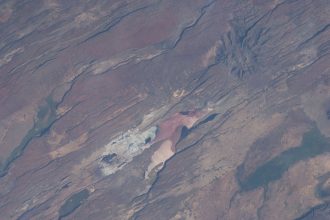
NASA’s Earth Observatory documented the transformation from orbit. Landsat 8 and 9 captured the region on 6 August, before the storms, and again on 14 August after the first. A Terra/MODIS image from 19 August shows snow cover reaching from the Andean cordillera westward almost to the Pacific — with one patch extending nearly to the port city of Antofagasta.
Snow, in the Atacama, at sea level’s doorstep.
Chile’s disaster-response agency SENAPRED issued warnings through regional director Roberto Muñoz of up to 25 centimetres of snow per day in the cordillera, with total accumulations approaching a metre in places. The freezing level — the altitude at which air temperature hits zero — was forecast to drop to about 2,400 metres, far below its normal position.
At the Chajnantor Plateau, a temperature of −7.91°C was recorded during the first event.
What “one of the driest places on Earth” actually means
The coastal town of Taltal recorded almost 40 millimetres of rain over three days. That is roughly ten times its average annual rainfall.
Not ten per cent more. Ten times the yearly total, in seventy-two hours.
Some Atacama weather stations have gone decades without measurable precipitation. The aridity is produced by two mechanisms working together: a persistent subtropical high-pressure system that suppresses rising air, and the cold Humboldt Current offshore, which chills the air above it so that it holds little moisture and produces coastal fog rather than rain. Between them, they have kept parts of the desert effectively rainless for geological spans of time.
René Garreaud, an atmospheric scientist at the University of Chile, put the frequency plainly: “We see these kinds of events only a few times, if any, per decade.”
Why the telescopes stopped
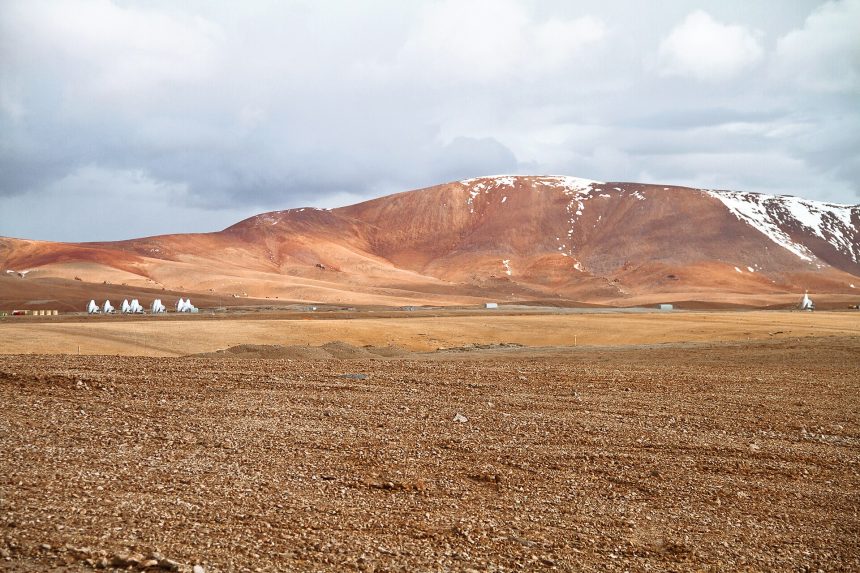
The Atacama Large Millimeter/submillimeter Array — ALMA — sits at roughly 5,000 metres on the Chajnantor Plateau. Sixty-six radio antennas, built by an international consortium at a cost in the billions, placed there for one reason: water vapour in the atmosphere absorbs the millimetre and submillimetre wavelengths ALMA is designed to observe. To see those wavelengths, you must put your telescope above as much of the atmosphere’s water as possible. The Atacama’s combination of extreme altitude and extreme dryness is close to the best compromise available on the planet’s surface.
During the second storm, ALMA suspended science operations and moved its antennas into a protective configuration — a survival mode designed to minimise wind loading and prevent damage to precision surfaces. Other observatories on the Chilean coast also halted work.
There is an irony worth sitting with. The instruments were placed in the Atacama specifically to escape atmospheric water. They were shut down by atmospheric water, in solid form, arriving at a site chosen because it does not do that.
Not only telescopes
Roughly 138 cargo trucks were stranded in San Pedro de Atacama waiting for border crossings to reopen.
This is where an unusual weather event becomes an economic one. The Atacama is not empty; it is one of the world’s most important mining regions, producing copper and a substantial share of global lithium. That industry runs on road freight across high-altitude passes into Argentina and Bolivia. Nothing in that supply chain is engineered for a metre of snow, because until now there has been no reason to engineer it that way.
The same holds for the towns. Buildings in a place that never rains are not built to shed water. Roads have no drainage. Flooding follows from quantities of precipitation that would be unremarkable almost anywhere else.
What this does and does not tell us about climate
An honest account has to separate two things.
What is established: the event happened, it was extraordinarily unusual, and it was documented by satellite and ground instruments. The mechanism is understood in general terms — incursions of moist air associated with cut-off low-pressure systems can occasionally break the region’s normal pattern, and two arrived in quick succession.
What is not established: whether this particular event was made more likely by climate change. That question requires a formal attribution study, which involves running climate models many times with and without human influence to see how the probability shifts. No such study has been published for this event. Researchers cited in the coverage flagged it as worth monitoring for a pattern of increasing extreme-precipitation incursions into hyper-arid zones — which is a research agenda, not a conclusion.
The distinction matters because the reflex in both directions is wrong. “Unusual weather, therefore climate change” is not evidence. Neither is “one event proves nothing, therefore ignore it.” A single event is a data point whose meaning depends on whether it turns out to be part of a trend — and that is precisely what attribution science is built to determine.
The measurement problem underneath
There is a subtler issue for the researchers who study this region, and it has nothing to do with politics.
The Atacama’s scientific value — for astronomy, for astrobiology, for testing instruments bound for Mars — rests on its stability. It is a natural laboratory precisely because conditions there have been extreme and consistent for a very long time. Microbial communities in Atacama soils are studied as analogues for what life might look like on a dry planet. Those communities are adapted to near-total absence of liquid water, and there is published work showing that unusual rainfall events can be lethal to them: organisms optimised for extreme dryness can be killed by water.
If events like this become more frequent, the desert does not simply become slightly wetter. It becomes a different kind of place, and some of what made it scientifically irreplaceable stops being true.
What happens next
ALMA and the other affected observatories were expected to resume normal operations once conditions cleared and staff had confirmed no equipment damage; no specific resumption date was given in the available coverage. No formal attribution study or follow-up research timeline has been announced.
The satellite record of the event is now permanent. Whether it reads, in twenty years, as a curiosity or as an early entry in a pattern is not something anyone can honestly answer today.
Why the Atacama is dry, in detail
Three mechanisms combine, and their overlap is what makes the desert exceptional rather than merely arid.
Subtropical high pressure. The Atacama sits under a persistent high-pressure cell where air descends. Descending air warms and its relative humidity falls, which suppresses cloud formation. This is the same mechanism that places most of the world’s great deserts around 30 degrees latitude.
The Humboldt Current. Cold water flows north along the Chilean coast. Air above cold water is cool and holds little moisture; it also forms a stable layer that resists rising. The result is coastal fog — the camanchaca — rather than rain.
The Andes. The mountains block moisture arriving from the Amazon basin to the east. Air rising over the range drops its water on the eastern slopes and arrives desiccated.
Most deserts have one or two of these. The Atacama has all three, which is why parts of it have hyper-arid cores where some stations have recorded no measurable rainfall for decades.
Breaking that requires an unusual synoptic setup — typically a cut-off low, a pocket of cold upper-level air that detaches from the main westerly flow and drifts north, carrying moisture into a region the normal circulation keeps dry. Two such systems in six days is the anomaly.
What ALMA is looking at, and why it must be dry
ALMA observes at millimetre and submillimetre wavelengths, and the reason is the science those wavelengths carry.
Cold objects — the dense clouds of gas and dust where stars form, protoplanetary discs around young stars, the chemistry of the interstellar medium — emit predominantly at these wavelengths. Visible-light telescopes cannot see into such clouds; ALMA sees through them.
The obstacle is water vapour, which absorbs strongly in exactly this range. Every millimetre of precipitable water in the column above the telescope degrades the signal. There is no way to correct for it after the fact beyond a point; the photons simply do not arrive.
This is why the array sits at 5,000 metres on the Chajnantor Plateau, above roughly half the atmosphere by mass and above most of its water. The site was chosen through years of survey work measuring atmospheric transparency at candidate locations worldwide. Very few places on Earth qualify.
The equipment is also delicate in a specific way. ALMA’s antennas hold surface accuracy measured in tens of microns across a twelve-metre dish. Ice loading, wind stress and thermal shock all threaten that precision, which is why they move to a stowed configuration rather than simply pausing observations.
The astrobiology stake
There is a scientific loss here that has nothing to do with telescopes.
Atacama soils host microbial communities adapted to near-total absence of liquid water, and they are studied intensively as analogues for what life might look like on Mars. NASA and ESA have tested instruments there for exactly this reason: it is the closest terrestrial approximation to conditions on a dry planet.
Published work has found that unusual rainfall can be lethal to these communities. Organisms optimised over long periods for extreme desiccation can be killed by sudden water — osmotic shock in cells built for an environment where liquid water essentially does not occur.
The implication is uncomfortable. If these events become more frequent, the Atacama does not simply become a slightly wetter desert. Some of what makes it scientifically irreplaceable — communities that have adapted over very long timescales to conditions found almost nowhere else — could be destroyed by the same storms that stop the telescopes.
How attribution science actually works
Since the obvious question is whether climate change caused this, it is worth explaining what answering it would require.
Attribution studies run climate models many times under two scenarios: the world as it is, with observed greenhouse gas concentrations, and a counterfactual world without human influence. Researchers then compare how often an event of the observed severity occurs in each set of runs.
The output is a probability ratio — an event may be found several times more likely, or its intensity increased by a measurable margin. It is not a yes-or-no verdict on a single storm, and responsible attribution scientists never phrase it as one.
Some event types are easier than others. Heatwaves attribute cleanly, because the physics is direct and models capture it well. Precipitation in complex terrain is much harder, because rainfall depends on small-scale processes that models represent coarsely. An event like this — unusual precipitation in a hyper-arid region with major topography — sits at the difficult end.
No such study has been published for these storms. Until one is, the honest answer is that this is a documented, very unusual event whose relationship to long-term climate change has not been assessed.
Sources
- NASA Earth Observatory, “Rare, Widespread Snow in the Atacama Desert,” 2026 — science.nasa.gov
- ScienceDaily, “One of Earth’s driest places was just covered in snow,” 1 September 2026 — sciencedaily.com
- The Watchers, “Snow and 90 km/h winds suspend ALMA observations in the Atacama Desert, Chile,” 18 August 2026 — watchers.news
- Earth.com, “One of the driest places on Earth was transformed by a rare winter storm,” 2026 — earth.com