



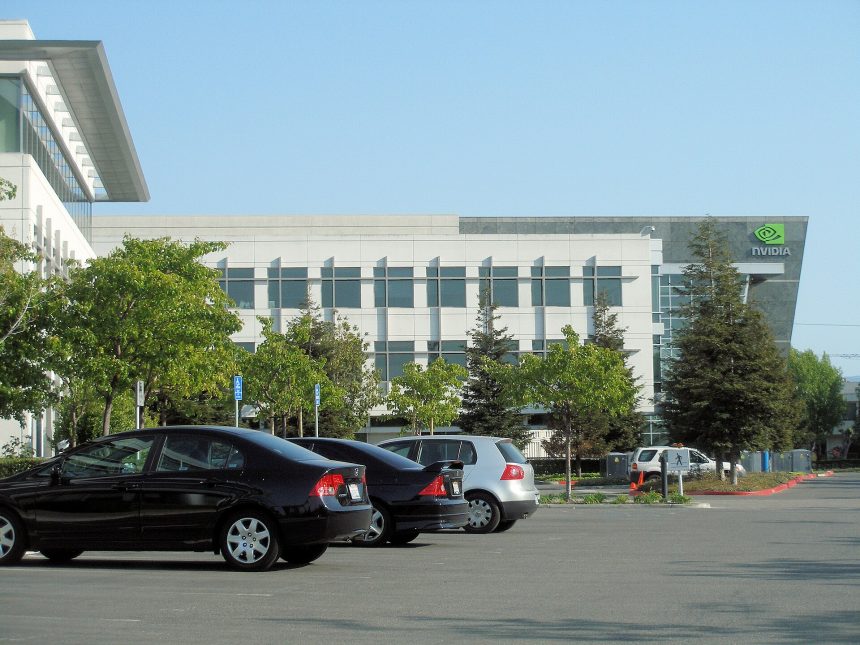
Nvidia reported $96.2 billion of revenue for a single quarter on 26 August — more than double the same quarter a year earlier. Then its chief financial officer spent part of the earnings call explaining why the company’s arrangements with its own customers are not what critics call them.
That second part is the more interesting one.
The numbers
For the second quarter of its 2027 fiscal year, ended in late July 2026, Nvidia reported:
- Total revenue: $96.2 billion, up 106 per cent year-on-year and 18 per cent on the previous quarter.
- Data Center revenue: $89.0 billion, up 117 per cent year-on-year — about 93 per cent of the total.
- GAAP net income: $59.688 billion, at a 75.0 per cent gross margin.
- Guidance for the next quarter: approximately $108.0 billion, plus or minus 2 per cent.
A 75 per cent gross margin on hardware is unusual to the point of being remarkable. Hardware businesses normally live in the 30s and 40s; margins like Nvidia’s belong to software companies. It is a direct measure of how few alternatives buyers currently believe they have.
“Now, compute is revenue,” chief executive Jensen Huang told the call, arguing that AI systems have moved from demonstrations to work that customers pay for.
The question the CFO chose to answer
Companies do not usually raise criticism of themselves on an earnings call. Nvidia did.
Chief financial officer Colette Kress addressed the practice of Nvidia investing capital in AI companies — frontier labs including OpenAI and Anthropic, and data-centre operators — which then spend on Nvidia chips.
“We know some will call this circular financing. We see it differently,” Kress said.
Her argument: the arrangements are low-risk and high-reward because Nvidia “gets paid twice” — once on the hardware sale, and again through a share of rental revenue when that hardware is used.
Naming the criticism yourself is a considered move. It signals that the question had become loud enough that ignoring it would itself be read as an answer.
What “circular financing” means, and why it worries people
The concern is not that these deals are hidden. They are disclosed. The concern is what they do to the information content of the revenue figure.
Ordinarily, a chip sale tells you something: a customer, spending its own money, judged the chips worth more than the price. Aggregate enough of those and you have a signal about genuine end demand.
When the supplier has funded part of the customer’s ability to buy, that signal degrades. Some portion of the revenue reflects Nvidia’s own capital returning as sales. How large that portion is, outsiders cannot determine from public filings.
This is not an accusation of fraud, and nothing here suggests improper accounting. It is a question about interpretation: how much of a record number is evidence about the world, and how much is evidence about the company’s balance-sheet strategy.
What the market priced in
One data point cuts through the debate because it comes from people paid to price risk rather than to have opinions about it.
Bill Birmingham, Managing Director at Rex Financial, noted that Nvidia’s five-year credit-default-swap spread repriced from 40 to 82 basis points after the company guaranteed capacity for OpenAI. A credit-default swap is insurance against a company failing to pay its debts; the spread is the premium. It roughly doubled.
Birmingham’s caution was about pricing power: “ROI for AI at the customer level is still unknown.”
That sentence contains the whole risk. Nvidia’s margins depend on customers continuing to buy at current prices. Those customers are buying on the expectation that AI deployments will generate returns. If enterprise returns arrive more slowly or more thinly than assumed, the correction does not appear first in Nvidia’s revenue — it appears in its customers’ budgets, a quarter or two later.
Two readings of the same quarter
The bullish reading: demand is real and broad, the company is capacity-constrained rather than demand-constrained, and investing in customers is ordinary ecosystem-building of the kind chip companies have always done. On this account the guidance of $108 billion is the honest expectation of a company that can see its order book.
The cautious reading: extraordinary concentration — 93 per cent of revenue from one segment, a large share from a small number of buyers — combined with supplier-financed demand and unproven customer-level returns describes a structure that is stable while confidence holds and reflexive when it does not.
Bloomberg’s reporting on 24 August framed a third pressure: competitive and geopolitical. Custom silicon from the large cloud providers, AMD’s accelerators, and export controls all bear on whether the current market position is durable, independent of how demand behaves.
Nothing in this article is investment advice, and none of the above should be read as a prediction. These are competing interpretations held by informed people, and the point of setting them side by side is that the data does not currently settle between them.
Why this matters beyond one company
Nvidia’s results have become the closest thing the AI industry has to a public thermometer. Most of the frontier labs are private and disclose little. The cloud providers bury AI spending inside broader capital expenditure. Nvidia sells the hardware nearly all of them use, and it reports quarterly.
That makes it the readable number in a largely unreadable sector — and it is precisely why the circular-financing question matters. A thermometer partly warmed by its own hand is harder to read.
What to watch
- Q3 FY2027 results, expected in late November 2026, against the $108 billion guidance.
- Customer-level ROI evidence. Enterprise reporting on returns from AI deployments is the leading indicator that precedes any change in chip demand.
- The credit-default-swap spread, as a running market judgment on the financing structure.
- Disclosure. Whether Nvidia begins breaking out revenue associated with entities it has invested in — which would answer the question directly.
How Nvidia came to hold this position
The dominance is not an accident of the last three years, and understanding its origin explains why it has been hard to dislodge.
Nvidia built graphics processors for games. Rendering a scene means performing the same arithmetic on very many pixels at once, so the chips were designed around massive parallelism — thousands of simple cores rather than a few complex ones.
Training a neural network turns out to require the same shape of computation: the same operation applied across enormous arrays of numbers. That coincidence made gaming hardware unexpectedly suitable for machine learning.
The decisive move was software. Nvidia released CUDA in 2007, a programming platform letting developers write general-purpose code for its GPUs, and invested in it for years before there was a market to justify it. By the time deep learning became commercially important, a generation of researchers had learned on CUDA, the libraries were written for CUDA, and the tooling assumed it.
That is the real barrier now. A competitor can match the silicon. Matching two decades of accumulated software, documentation, trained engineers and framework support is a longer project — which is why Nvidia’s margins have survived the arrival of credible alternative hardware.
What could actually change the picture
Three pressures are worth tracking, and none is a share-price forecast.
Custom silicon. The largest cloud providers have designed their own AI accelerators. They do not need to beat Nvidia on general performance — only to run their own workloads at acceptable cost. Every workload moved to in-house silicon is demand removed from the market rather than competed for within it.
Inference versus training. Training a model is a concentrated, compute-intensive exercise where Nvidia’s advantage is strongest. Running the trained model — inference — is a different problem, continuous and cost-sensitive, and one where specialised hardware competes more effectively. As deployment matures, the balance of industry spending shifts from the first toward the second.
Export controls. Restrictions on advanced chip sales to China remove a large market and create incentives for domestic alternatives that would not otherwise have been funded.
Reading a quarterly report without being misled
Some general principles, useful well beyond this company.
Guidance is a forecast made by an interested party. It carries information — management can see the order book — but it is also a number the company will be judged against, which creates an incentive to set it where it can be beaten.
Concentration is a risk that does not appear as a line item. Ninety-three per cent of revenue from one segment means the business is a bet on one market. That is not a criticism; it is a description of the risk profile, and it is invisible in a headline growth rate.
Gross margin measures pricing power. Seventy-five per cent says customers currently have limited alternatives. It is the number to watch for early evidence that competition is biting, because it moves before revenue does.
Related-party revenue is the hardest thing to assess from outside. Where a supplier has funded customers, the disclosure needed to separate genuine third-party demand from recycled capital is generally not published.
None of this is a view on whether the company is a good or bad investment, a question this publication does not address and readers should take to a regulated adviser if they need it.
The bubble question, stated fairly
It is worth separating two claims that get merged.
“AI is useless” is not a serious position, and almost nobody credible holds it. The technology does real work that people pay for.
“AI infrastructure spending may be running ahead of near-term returns” is a different and much more defensible claim, and it is compatible with the technology being genuinely valuable.
Infrastructure build-outs have historically overshot even when the underlying technology transformed the economy. Railways and fibre-optic networks are the standard examples: enormous capital destroyed, enormous lasting value created, and the two outcomes separated by years and by which investors held the assets at which point.
What would distinguish the cases here is evidence about enterprise returns — whether organisations deploying these systems are capturing value proportionate to what they are spending. That evidence is accumulating slowly and is not yet decisive in either direction.
Sources
- Nvidia Newsroom, “NVIDIA Announces Financial Results for Second Quarter Fiscal 2027,” 26 August 2026 — nvidianews.nvidia.com
- Fortune, “Nvidia unleashes 70% growth bombshell and defends against ‘circular financing’ doomsayers,” 26 August 2026 — fortune.com
- CNBC, “Nvidia earnings takeaways,” 26 August 2026 — cnbc.com
- Bloomberg, “Nvidia’s Trillion-Dollar Chip Market Has Friends and Foes Closing In,” 24 August 2026 — bloomberg.com